LLM Integration
The LLM component in ExtractThinker acts as a bridge between your document processing pipeline and various Language Model providers. It handles request formatting, response parsing, and provider-specific optimizations.
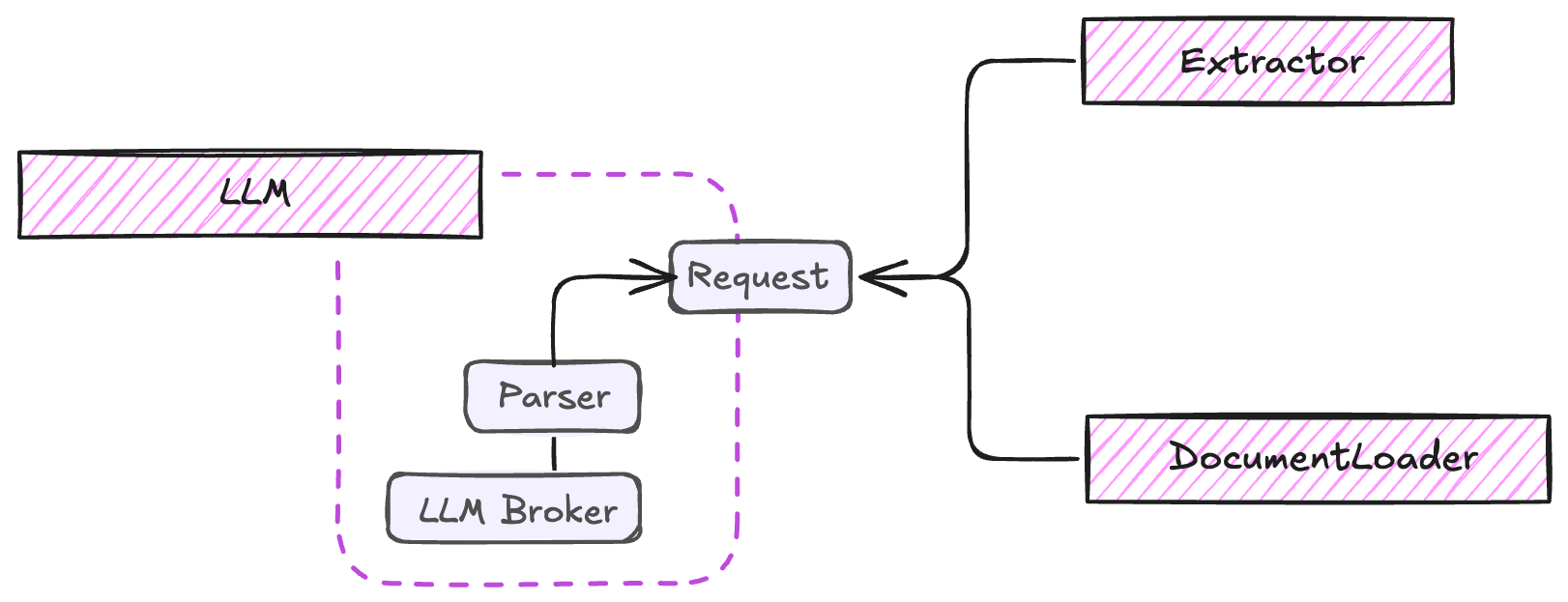
Base LLM Implementation
import asyncio
from typing import List, Dict, Any, Optional
import instructor
import litellm
from litellm import Router
from extract_thinker.llm_engine import LLMEngine
from extract_thinker.utils import add_classification_structure, extract_thinking_json

# Helper to build the dynamic prompt used when `is_dynamic=True`.
# We expose it as a standalone function so that callers (or subclasses)
# can supply their own variants if needed.


def build_dynamic_prompt(structure: str, *, think_tag: str = "think") -> str:
    """Return the dynamic prompt used for classification style requests.

    Args:
        structure: The JSON structure/fields to be returned by the model.
        think_tag: The XML-style tag that should wrap the model's chain-of-thought.

    This helper allows downstream users to customise the surrounding text
    (for example, changing the tag name or adding extra instructions) rather
    than editing a hard-coded string inside *llm.py*.
    """

    return (
        f"Please provide your thinking process within <{think_tag}> tags, "
        "followed by your JSON output.\n\n"
        "JSON structure:\n"
        f"{structure}\n\n"
        "OUTPUT example:\n"
        f"<{think_tag}>\n"
        "Your step-by-step reasoning and analysis goes here...\n"
        f"</{think_tag}>\n\n"
        "##JSON OUTPUT\n"
        "{\n    ...\n}"  # placeholder keeps JSON fence out of model context
    )

class LLM:
    TIMEOUT = 3000  # Timeout in milliseconds
    DEFAULT_TEMPERATURE = 0
    THINKING_BUDGET_TOKENS = 8000
    DEFAULT_PAGE_TOKENS = 1500  # Each page has this many tokens (text + image)
    DEFAULT_THINKING_RATIO = 1/3  # Thinking budget as a fraction of content tokens
    MAX_TOKEN_LIMIT = 120000  # Maximum token limit (for Claude 3.7 Sonnet)
    MAX_THINKING_BUDGET = 64000  # Maximum thinking budget
    MIN_THINKING_BUDGET = 1200  # Minimum thinking budget
    DEFAULT_OUTPUT_TOKENS = 32000

    # A single default completion-token limit that is accepted by the vast
    # majority of models.  If a model supports more (or you need fewer), pass
    # `token_limit=` when instantiating `LLM` to override this value.
    DEFAULT_MAX_COMPLETION_TOKENS = 8000

    def __init__(
        self,
        model: str,
        token_limit: int = None,
        backend: LLMEngine = LLMEngine.DEFAULT,
        completion_kwargs: Optional[Dict[str, Any]] = None,
        structured_output: bool = False,
    ):
        """Initialize LLM with specified backend.

        Args:
            model: The model name (e.g. "gpt-4", "claude-3")
            token_limit: Optional maximum output tokens, overriding the default
            backend: LLMBackend enum (default: LITELLM)
            completion_kwargs: Provider options such as logprobs and top_logprobs
            structured_output: Request provider-native JSON Schema output (provider support required)
        """
        if not isinstance(structured_output, bool):
            raise ValueError("structured_output must be a boolean")
        if structured_output and backend != LLMEngine.DEFAULT:
            raise ValueError("structured_output requires the default LiteLLM backend")
        self.structured_output = structured_output
        self.model = model
        if token_limit is not None and (isinstance(token_limit, bool) or not isinstance(token_limit, int) or token_limit <= 0):
            raise ValueError("token_limit must be a positive integer")
        self.token_limit = token_limit
        self.completion_kwargs = dict(completion_kwargs or {})
        reserved = {"model", "messages", "response_model", "max_tokens", "max_completion_tokens", "stream"}
        if structured_output:
            reserved.add("response_format")
        if reserved.intersection(self.completion_kwargs):
            raise ValueError(f"completion_kwargs cannot override: {sorted(reserved.intersection(self.completion_kwargs))}")
        if backend != LLMEngine.DEFAULT and self.completion_kwargs:
            raise ValueError("completion_kwargs are supported only by the default LiteLLM backend")
        self.last_completion = None
        self.router = None
        self.is_dynamic = False
        self.backend = backend
        self.temperature = self.DEFAULT_TEMPERATURE
        self.is_thinking = False  # Initialize is_thinking flag
        self.page_count = None  # Initialize page count
        self.thinking_budget = self.THINKING_BUDGET_TOKENS  # Default thinking budget
        self.thinking_token_limit: Optional[int] = None

        if self.backend == LLMEngine.DEFAULT:
            self.client = instructor.from_litellm(
                litellm.completion,
                mode=instructor.Mode.JSON_SCHEMA if structured_output else instructor.Mode.MD_JSON
            )
            self.agent = None
        elif self.backend == LLMEngine.PYDANTIC_AI:
            self._check_pydantic_ai()
            from pydantic_ai import Agent
            from pydantic_ai.models import KnownModelName
            from typing import cast

            self.client = None
            self.agent = Agent(
                cast(KnownModelName, self.model)
            )
        else:
            raise ValueError(f"Unsupported backend: {self.backend}")

    @staticmethod
    def _check_pydantic_ai():
        """Check if pydantic-ai is installed."""
        try:
            import pydantic_ai
        except ImportError:
            raise ImportError(
                "Could not import pydantic-ai package. "
                "Please install it with `pip install pydantic-ai`."
            )

    @staticmethod
    def _get_pydantic_ai():
        """Lazy load pydantic-ai."""
        try:
            import pydantic_ai
            return pydantic_ai
        except ImportError:
            raise ImportError(
                "Could not import pydantic-ai package. "
                "Please install it with `pip install pydantic-ai`."
            )

    def load_router(self, router: Router) -> None:
        """Load a LiteLLM router for model fallbacks."""
        if self.backend != LLMEngine.DEFAULT:
            raise ValueError("Router is only supported with LITELLM backend")
        if self.structured_output:
            raise ValueError("structured_output does not support the raw LiteLLM router; use direct LLM routes")
        self.router = router

    def set_temperature(self, temperature: float) -> None:
        """Set the temperature for LLM requests.

        Args:
            temperature (float): Temperature value between 0 and 1
        """
        self.temperature = temperature

    def set_thinking(self, is_thinking: bool) -> None:
        """Set whether the LLM should handle thinking.

        Args:
            is_thinking (bool): Whether to enable thinking
        """
        self.is_thinking = is_thinking
        self.temperature = 1

    def set_dynamic(self, is_dynamic: bool) -> None:
        """Set whether the LLM should handle dynamic content.

        When dynamic is True, the LLM will attempt to parse and validate JSON responses.
        This is useful for handling structured outputs like masking mappings.

        Args:
            is_dynamic (bool): Whether to enable dynamic content handling
        """
        if is_dynamic and self.structured_output:
            raise ValueError("Dynamic parsing cannot be combined with structured_output")
        self.is_dynamic = is_dynamic

    def set_page_count(self, page_count: int) -> None:
        """Set the page count to calculate token limits for thinking.

        Each page is assumed to have DEFAULT_PAGE_TOKENS tokens (text + image).
        Thinking budget is calculated as DEFAULT_THINKING_RATIO of the content tokens.

        Args:
            page_count (int): Number of pages in the document
        """
        if isinstance(page_count, bool) or not isinstance(page_count, int) or page_count <= 0:
            raise ValueError("Page count must be a positive integer")

        self.page_count = page_count

        # Calculate content tokens
        limit = self.token_limit if self.token_limit is not None else self.MAX_TOKEN_LIMIT
        content_tokens = min(page_count * self.DEFAULT_PAGE_TOKENS, limit)

        # Calculate thinking budget (1/3 of content tokens)
        thinking_tokens = int(page_count * self.DEFAULT_PAGE_TOKENS * self.DEFAULT_THINKING_RATIO)

        # Apply min/max constraints
        thinking_tokens = max(thinking_tokens, self.MIN_THINKING_BUDGET)
        thinking_tokens = min(thinking_tokens, self.MAX_THINKING_BUDGET)
        # A reasoning budget must fit inside the requested output budget.
        output_limit = min(content_tokens, self._get_model_max_tokens())
        thinking_tokens = min(thinking_tokens, max(0, output_limit - 1))

        # Update token limit and thinking budget
        self.thinking_token_limit = content_tokens
        self.thinking_budget = thinking_tokens

    def request(
        self,
        messages: List[Dict[str, str]],
        response_model: Optional[str] = None
    ) -> Any:
        # Handle Pydantic-AI backend differently
        if self.backend == LLMEngine.PYDANTIC_AI:
            # Combine messages into a single prompt
            combined_prompt = " ".join([m["content"] for m in messages])
            try:
                result = asyncio.run(
                    self.agent.run(
                        combined_prompt,
                        result_type=response_model if response_model else str
                    )
                )
                return result.data
            except Exception as e:
                raise ValueError(f"Failed to extract from source: {str(e)}")

        # Uncomment the following lines if you need to calculate max_tokens
        # contents = map(lambda message: message['content'], messages)
        # all_contents = ' '.join(contents)
        # max_tokens = num_tokens_from_string(all_contents)

        # if is sync, response model is None if dynamic true and used for dynamic parsing after llm request
        request_model = None if self.is_dynamic else response_model

        # Add model structure and prompt engineering if dynamic parsing is enabled
        working_messages = messages.copy()
        if self.is_dynamic and response_model:
            structure = add_classification_structure(response_model)
            prompt = build_dynamic_prompt(structure)
            working_messages.append({
                "role": "system",
                "content": prompt
            })

        # Use router or direct call based on thinking state
        if self.router:
            response = self._request_with_router(working_messages, request_model)
        else:
            response = self._request_direct(working_messages, request_model)

        # If response_model is provided, return the response directly
        if self.is_dynamic == False:
            return response

        # Otherwise get content and handle dynamic parsing if enabled
        content = response.choices[0].message.content
        if self.is_dynamic:
            return extract_thinking_json(content, response_model)

        return content

    def _request_with_router(self, messages: List[Dict[str, str]], response_model: Optional[str]) -> Any:
        """Handle request using router with or without thinking parameter"""
        max_tokens = self._get_model_max_tokens()
        if self.token_limit is not None:
            max_tokens = min(self.token_limit, max_tokens)
        elif self.is_thinking:
            max_tokens = min(self.thinking_token_limit, max_tokens) if self.thinking_token_limit else max_tokens

        params = {
            "model": self.model,
            "messages": messages,
            "response_model": response_model,
            "temperature": self.temperature,
            "timeout": self.TIMEOUT,
            "max_completion_tokens": max_tokens,
        }
        params.update(self.completion_kwargs)
        if self.is_thinking:
            if litellm.supports_reasoning(self.model):
                # Add thinking parameter for supported models
                thinking_param = {
                    "type": "enabled",
                    "budget_tokens": self.thinking_budget
                }
                params["thinking"] = thinking_param
            else:
                print(f"Warning: Model {self.model} doesn't support thinking parameter, proceeding without it.")

        return self.router.completion(**params)

    def _request_direct(self, messages: List[Dict[str, str]], response_model: Optional[str]) -> Any:
        """Handle direct request with or without thinking parameter"""
        max_tokens = self._get_model_max_tokens()
        if self.token_limit is not None:
            max_tokens = min(self.token_limit, max_tokens)
        elif self.is_thinking:
            max_tokens = min(self.thinking_token_limit, max_tokens) if self.thinking_token_limit else max_tokens

        base_params = {
            "model": self.model,
            "messages": messages,
            "temperature": self.temperature,
            "response_model": response_model,
            "max_retries": 1,
            "max_completion_tokens": max_tokens,
            "timeout": self.TIMEOUT,
        }
        base_params.update(self.completion_kwargs)

        if self.is_thinking:
            if litellm.supports_reasoning(self.model):
                # Try with thinking parameter
                thinking_param = {
                    "type": "enabled",
                    "budget_tokens": self.thinking_budget
                }
                base_params["thinking"] = thinking_param
            else:
                print(f"Warning: Model {self.model} doesn't support thinking parameter, proceeding without it.")

        response = self.client.chat.completions.create(**base_params)
        self.last_completion = getattr(response, "_raw_response", None)
        return response

    def raw_completion(self, messages: List[Dict[str, str]]) -> str:
        """Make raw completion request without response model."""
        if self.backend == LLMEngine.PYDANTIC_AI:
            # Combine messages into a single prompt
            combined_prompt = " ".join([m["content"] for m in messages])
            try:
                result = asyncio.run(
                    self.agent.run(
                        combined_prompt,
                        result_type=str
                    )
                )
                return result.data
            except Exception as e:
                raise ValueError(f"Failed to extract from source: {str(e)}")

        max_tokens = self._get_model_max_tokens()
        if self.token_limit is not None:
            max_tokens = min(self.token_limit, max_tokens)
        elif self.is_thinking:
            max_tokens = min(self.thinking_token_limit, max_tokens) if self.thinking_token_limit else max_tokens

        params = {
            "model": self.model,
            "messages": messages,
            "max_completion_tokens": max_tokens,
        }
        params.update(self.completion_kwargs)

        if self.is_thinking:
            if litellm.supports_reasoning(self.model):
                # Add thinking parameter for supported models
                thinking_param = {
                    "type": "enabled",
                    "budget_tokens": self.thinking_budget
                }
                params["thinking"] = thinking_param
            else:
                print(f"Warning: Model {self.model} doesn't support thinking parameter, proceeding without it.")

        if self.router:
            raw_response = self.router.completion(**params)
        else:
            raw_response = litellm.completion(**params)

        self.last_completion = raw_response
        return raw_response.choices[0].message.content

    def set_timeout(self, timeout_ms: int) -> None:
        """Set the timeout value for LLM requests in milliseconds."""
        self.TIMEOUT = timeout_ms

    def _get_model_max_tokens(self) -> int:
        """Return the default maximum completion-token limit.

        This constant (DEFAULT_MAX_COMPLETION_TOKENS) is meant to work for ~99 %
        of models.  If you need a different value, supply `token_limit=` when
        creating the `LLM` instance.
        """

        return self.token_limit if self.token_limit is not None else self.DEFAULT_MAX_COMPLETION_TOKENS
The architecture supports two different stacks:
Default Stack: Combines instructor and litellm
- Uses instructor for structured outputs with Pydantic
- Leverages litellm for unified model interface
Pydantic AI Stack 🧪 In Beta
- All-in-one solution for Pydantic model integration
- Handles both model interfacing and structured outputs
- Built by the Pydantic team (Learn more)
Backend Options
from extract_thinker import LLM
from extract_thinker.llm_engine import LLMEngine

# Initialize with default stack (instructor + litellm)
llm = LLM("gpt-4o")

# Or use Pydantic AI stack (Beta)
llm = LLM("openai:gpt-4o", backend=LLMEngine.PYDANTIC_AI)
ExtractThinker supports two LLM stacks:
Default Stack (instructor + litellm)
The default stack combines instructor for structured outputs and litellm for model interfacing. It leverages LiteLLM's unified API for consistent model access:
Pydantic AI Stack (Beta)
An alternative all-in-one solution for model integration powered by Pydantic AI:
Pydantic AI Limitations
- Batch processing is not supported with the Pydantic AI backend
- Router functionality is not available
- Requires the
pydantic-aipackage to be installed
Features
Thinking Models
ExtractThinker's LLM integration includes support for "thinking models" that expose their reasoning process:
from extract_thinker import LLM

# Initialize LLM
llm = LLM("gpt-4o")

# Enable thinking mode
llm.set_thinking(True)  # Automatically sets temperature to 1.0
Learn more about Thinking Models and how they improve extraction results.
Router Support
ExtractThinker supports LiteLLM's router functionality for model fallbacks:
from extract_thinker import LLM
from litellm import Router

# Initialize router with fallbacks
router = Router(
    model_list=[
        {"model_name": "gpt-4o", "litellm_params": {"model": "gpt-4o"}},
        {"model_name": "claude-3-opus-20240229", "litellm_params": {"model": "claude-3-opus-20240229"}},
    ],
    fallbacks=[
        {"gpt-4o": "claude-3-opus-20240229"}
    ]
)

# Initialize LLM with router
llm = LLM("gpt-4o")
llm.load_router(router)
This enables seamless fallbacks between different providers if a request fails.
Output limits and provider options
token_limit overrides the default completion budget (8,000 output tokens).
It also bounds the page-based reasoning estimate. It does not enlarge a
model's input context window; choose a compatible output budget and use
pagination for input documents that exceed the provider's context limit.
from extract_thinker import LLM

llm = LLM(
    "your-provider/your-model",
    token_limit=4000,
    completion_kwargs={"logprobs": True, "top_logprobs": 3},
)
completion_kwargs forwards provider options through the default LiteLLM backend
for structured, routed and raw calls. Support for these options depends on the
selected provider/model. The mapping cannot replace the model, messages,
response schema, streaming mode or token budget; use the corresponding public
configuration instead.
After a direct structured request, llm.last_completion exposes the provider
response attached by Instructor, if available. Raw completion also stores its
provider response there. For providers exposing log probabilities, inspect
llm.last_completion.choices[0].logprobs. This metadata is optional, describes
the latest call, and should not be used to associate results across concurrent
calls on the same LLM instance. Extraction still returns the validated contract.