Concatenate Strategy
The Concatenate strategy is designed to handle content that exceeds the LLM's context window by splitting it into manageable chunks, processing them separately, and then combining the results.
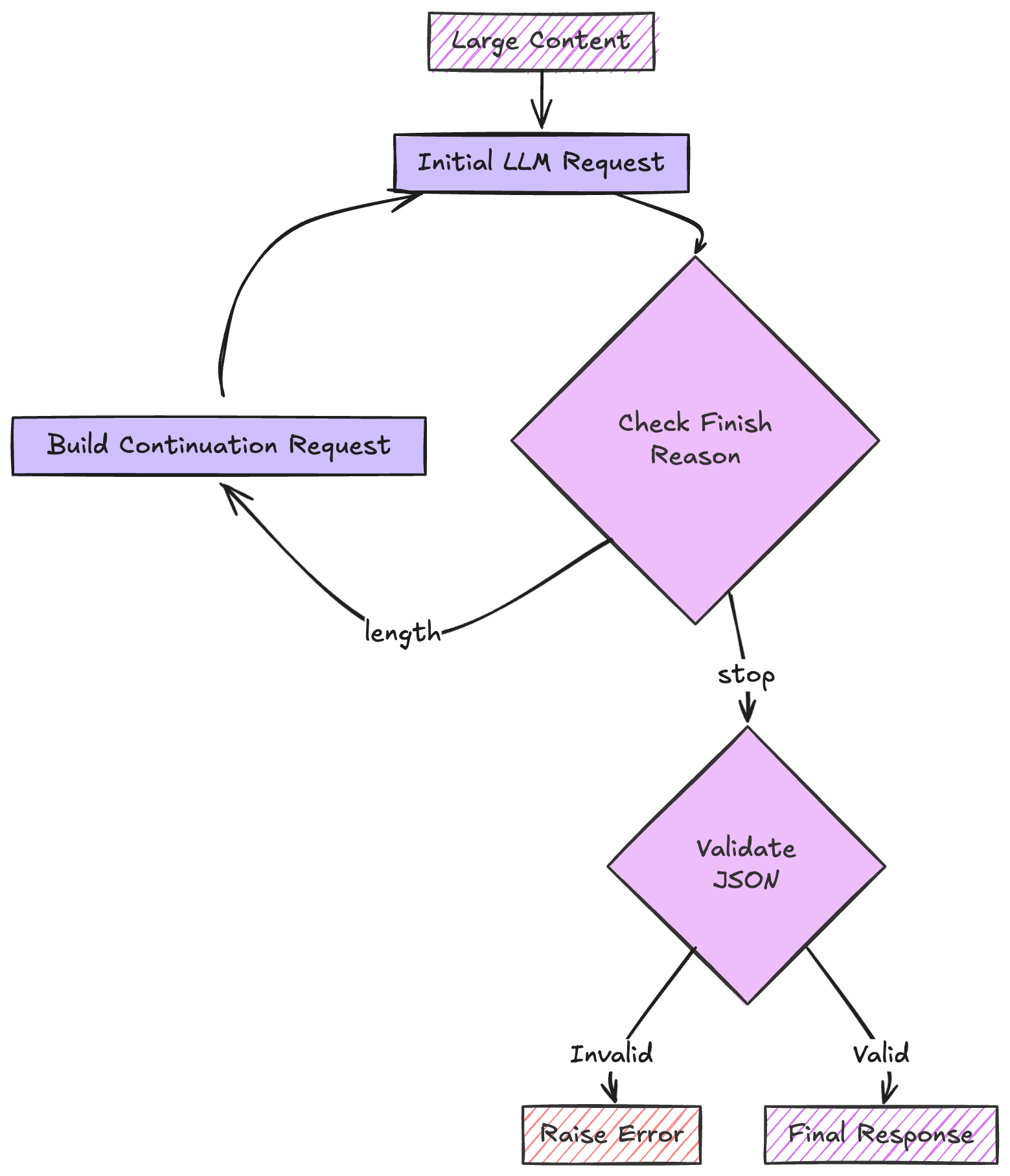
How It Works
1. Initial Request
- Sends the content to the LLM with the desired response structure
- Monitors the LLM's response completion status
2. Continuation Process
- If response is truncated (finish_reason="length"), builds a continuation request
- Includes previous partial response for context
- Continues until LLM indicates completion
3. Validation
- When LLM indicates completion (finish_reason="stop")
- Validates the combined JSON response
- Raises error if invalid JSON is received on completion
4. Response Processing
- Combines all response parts
- Validates against the specified response model
- Returns structured data
Usage
from extract_thinker import Extractor
from extract_thinker.models.completion_strategy import CompletionStrategy

extractor = Extractor()
extractor.load_llm("gpt-4o")

result = extractor.extract(
    file_path,
    ResponseModel,
    completion_strategy=CompletionStrategy.CONCATENATE
)
Benefits
- Handles Large Content: Can process documents larger than the output context window
- Maintains Context: Attempts to keep related content together
Implementation Details
Concatenation Handler Implementation
The ConcatenationHandler implements the CONCATENATE strategy:
import copy
import yaml
import json
import re
from typing import Any, Dict, List, Optional
from pydantic import BaseModel
from extract_thinker.completion_handler import CompletionHandler
from extract_thinker.utils import encode_image, add_classification_structure

class ConcatenationHandler(CompletionHandler):
    def __init__(self, llm):
        super().__init__(llm)
        self.json_parts = []

    @staticmethod
    def _clean_fragment(response: str) -> str:
        """Remove surrounding Markdown fences without altering JSON string values."""
        response = re.sub(r"\A\s*```(?:json)?[ \t]*\r?\n?", "", response)
        return re.sub(r"\r?\n?```\s*\Z", "", response)

    def _is_valid_json_continuation(self, response: str) -> bool:
        # A continuation can start inside a string, number, or closing bracket.
        return isinstance(response, str) and bool(response.strip())

    def handle(self, content: Any, response_model: type[BaseModel], vision: bool = False, extra_content: Optional[str] = None) -> Any:
        self.json_parts = []
        messages = self._build_messages(content, vision, response_model)
        if extra_content:
            self._add_extra_content(messages, extra_content)
        initial_messages = copy.deepcopy(messages)
        last_error = None
        for attempt in range(4):
            # Provider failures are not JSON continuations: preserve their cause.
            response = self.llm.raw_completion(messages)
            if not self._is_valid_json_continuation(response):
                last_error = ValueError("Empty JSON continuation")
                continue
            self.json_parts.append(self._clean_fragment(response))
            try:
                parsed = json.loads("".join(self.json_parts))
            except json.JSONDecodeError as exc:
                last_error = exc
                messages = self._build_continuation_messages(messages, response)
                continue
            try:
                return response_model.model_validate(parsed)
            except ValueError as exc:
                # Complete JSON with the wrong schema needs replacement, not a suffix.
                last_error = exc
                self.json_parts = []
                messages = copy.deepcopy(initial_messages)
                messages.append({
                    "role": "user",
                    "content": "The previous output did not match the required schema. "
                               "Return a complete JSON object matching the schema, including all required fields.",
                })
        raise ValueError("Maximum retries reached while completing JSON. "
                         "If the input exceeds the model context, use PAGINATE; "
                         "CONCATENATE only continues truncated output.") from last_error

    def _process_json_parts(self, response_model: type[BaseModel]) -> Any:
        """Validate collected JSON; do not change whitespace inside string values."""
        if not self.json_parts:
            raise ValueError("No JSON content collected")
        combined = "".join(self._clean_fragment(part) for part in self.json_parts)
        return response_model.model_validate_json(combined)

    def _build_continuation_messages(
        self,
        messages: List[Dict[str, Any]],
        partial_content: str
    ) -> List[Dict[str, Any]]:
        """Build messages for continuation request."""
        continuation_messages = copy.deepcopy(messages)

        # Add partial response as assistant message
        continuation_messages.append({
            "role": "assistant",
            "content": partial_content
        })

        # Add continuation prompt
        continuation_messages.append({
            "role": "user",
            "content": "Continue the JSON exactly where it stopped. Return only the remaining "
                       "characters, without repeating the prefix or adding Markdown fences."
        })

        return continuation_messages

    def _build_messages(self, content: Any, vision: bool, response_model: type[BaseModel]) -> List[Dict[str, Any]]:
        """Build messages for LLM request."""
        system_message = {
            "role": "system",
            "content": (
                "You are a server API that receives document information and returns specific fields in JSON format.\n"
                "Please follow the response structure exactly as specified below.\n\n"
                f"{add_classification_structure(response_model)}\n"
            )
        }

        if vision:
            message_content = self._build_vision_content(content)
            messages = [
                system_message,
                {
                    "role": "user",
                    "content": message_content
                }
            ]
        else:
            message_content = self._build_text_content(content)
            messages = [
                system_message,
                {
                    "role": "user",
                    "content": message_content
                }
            ]

        return messages

    def _build_vision_content(self, content: Any) -> List[Dict[str, Any]]:
        """Build content for vision request."""
        message_content = []

        if isinstance(content, list):
            # Handle list of content items
            for item in content:
                # Add text content if available
                if isinstance(item, dict) and "content" in item:
                    message_content.append({
                        "type": "text",
                        "text": f"##Content\n\n{item['content']}"
                    })

                # Add images if available
                if isinstance(item, dict):
                    images = []
                    if "images" in item and isinstance(item["images"], list):
                        images.extend(item["images"])
                    if "image" in item and item["image"] is not None:
                        images.append(item["image"])

                    for img in images:
                        if img:
                            message_content.append({
                                "type": "image_url",
                                "image_url": {
                                    "url": f"data:image/jpeg;base64,{encode_image(img)}"
                                }
                            })
        else:
            # Handle single item
            if isinstance(content, dict):
                # Add text content if available
                if "content" in content:
                    message_content.append({
                        "type": "text",
                        "text": f"##Content\n\n{content['content']}"
                    })

                # Add images
                images = []
                if "images" in content and isinstance(content["images"], list):
                    images.extend(content["images"])
                if "image" in content and content["image"] is not None:
                    images.append(content["image"])

                for img in images:
                    if img:
                        message_content.append({
                            "type": "image_url",
                            "image_url": {
                                "url": f"data:image/jpeg;base64,{encode_image(img)}"
                            }
                        })

        return message_content

    def _build_text_content(self, content: Any) -> str:
        """Build content for text request."""
        if isinstance(content, dict):
            return f"##Content\n\n{yaml.dump(content)}"
        elif isinstance(content, str):
            return f"##Content\n\n{content}"
        else:
            return f"##Content\n\n{str(content)}"

    def _add_extra_content(self, messages: List[Dict[str, Any]], extra_content: str) -> None:
        """Add extra content to messages."""
        messages.insert(1, {
            "role": "user",
            "content": f"##Extra Content\n\n{extra_content}"
        })
When to Use
CONCATENATE is the best choice when:
Context window is large
- For models like gpt-4o, claude-3-5-sonnet, etc.
The content is not too large
- Should be used for documents that are not too large (e.g. 500 pages)
For handling bigger documents, consider using the PAGINATE strategy.